

Read time: 5min
Join 23,118 Good Busy leaders
"The leader of the past was a person who knew how to tell. The leader of the future will be a person who knows how to ask." - Peter Drucker
Hi,
How was your last week?
“We have a no meeting policy on Friday, so that’s the only day I can do my real work. But by then, I have no energy left. I can’t focus.”
My client told me that. And the problem is they thought the problem was them. They wanted to fix themselves.
But let me ask you something: how much energy do you have on Fridays?
Exactly.
The problem isn’t you. The problem is the structure — a policy that wasn’t designed around how humans actually operate. And when the structure is unrealistic, you question yourself. You feel guilty and wonder why everyone else seems to manage. They don’t. Just like you, they don’t say it out loud.
I experienced the same policy twelve years ago, long before Covid made it trendy. No meetings, no emails on Fridays. Guess what happened? We moved to DMs. We didn’t want to break “the rule” but we still needed to communicate and get things done.
It didn’t solve the meeting and email problem. It relocated it and created new ones: more lost in translation, delayed decisions, and quite frankly, a lot of frustration.
Why share this with you?
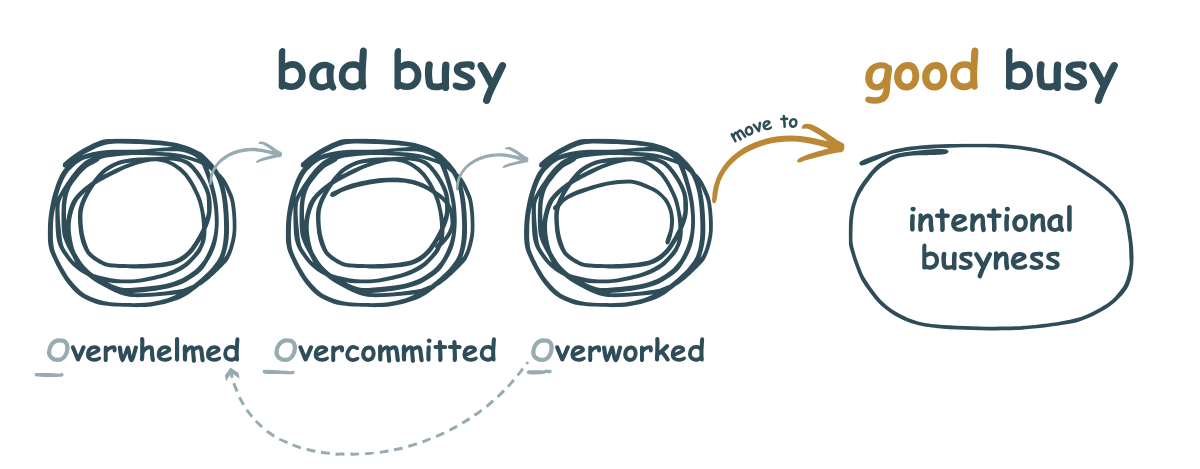
Because rigid structures and policies that don’t consider how we function create a specific kind of problem. One that’s persistent and exhausting: the work that simply shouldn’t exist. The bad busy work.
You are not lazy or incompetent. It’s just the rules of the game were designed without asking the right questions because questions stopped being rewarded. Questioning became a synonym of being “difficult” (a former colleague called me a pain in the a**).
But when nobody asks questions, the wrong work multiplies with a speed of light. It overwhelms, overworks you. It takes away your energy, focus, and time from work you’d be proud of delivering (and all the other things you want to do after work but put on hold).
Understanding where this bad busy work is hiding in your day is the first step. Otherwise, it only gets worse.
the why
In April, I heard Terence Mauri, founder of Hack Future Lab and MIT faculty member, give a strong name to this unnecessary work:
BMI: Bureaucratic Mass Index.
The weight of processes, policies, approvals, and complexity that accumulates in organizations over time. Some of it was designed with good intention. But simple things become complicated fast when nobody stops to question them.
Terence says we’ve become complexifiers instead of simplifiers. Complicated makes us look smart. We codify, automate, add defaults, create policies and call it structure when more often than not it’s just more BMI. More bureaucratic mass. More bureaucratic mess.
Companies invest in more technology, more speed, more tools instead of the one thing that actually created the company in the first place, that actually brings results: human intelligence. Because at the end of the day, companies are groups of people. Technology was invented by humans. And yet somehow, we’re more wowed by what AI can automate rather than how human intelligence has created it.
One of my clients who joined The Good Busy Reset to learn how to eliminate that mess told me that their SAP system is so complicated that it demotivates.
That’s exactly what complexity does. It makes people question their abilities rather than questioning the process. It creates procrastination not because people are disengaged but because the end is ambiguous, the why is unclear, and the how is discouraging.
As Peter Drucker said: the leader of the future will be a person who knows how to ask.
Most structures today don’t teach you to ask. Quite the opposite: they teach you to comply.
But my bet is that now, more than ever, return on investment — on your time, on your intelligence, and on technology — comes from thinking, judgement, and questions. Not compliance.
the how
Here’s another example of BMI that might help you identify yours.
Last week I received an email from my insurance company ending with: “Please feel free to contact me for any questions or queries.” In bold.
So I did. I emailed two questions. Thirty minutes later I got their reply:
“Kindly note that if you require any further information, it would be best to contact [phone number] to receive the most accurate and appropriate response.”
This reply also ended with: “Please feel free to contact me for any further questions or queries.” Also in bold.
In my corporate days, I wrote dozens of templates: for customer service teams, social media teams, sales teams. I learned templates are useful because no structure at all is chaos. But templates are too often the solution to a problem of poor (quick) hiring, or lack of training and coaching. They’re a safety net that catches all the wrong things. They prevent people from critical thinking, from believing they’re smart and capable.
The customer sends an email, then calls, gets confused, gets frustrated. The agent escalates. The manager gets involved. And it’s another crisis.
What you actually need is structure that questions, that gives you the space to use your strengths, build agility, and make thoughtful decisions. That’s the difference between BMI work and what Terence calls ROI work — Return on Intelligence. That to me is the difference between bad and Good Busy.
The question worth asking this week: which one is filling your days?
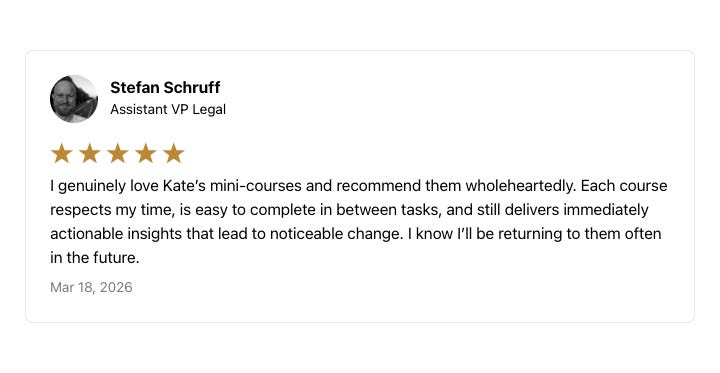
6 Tips for Writing Emails that Save Time mini course (under 8min) covers exactly that. Access all mini courses when you upgrade your subscription along with upcoming free event end of June.
your play of the week
Reduce your BMI 🧹
This week, question one structure in your day: a status update meeting, no meeting Fridays, a template, an approval process.
Ask: Is this solving the real problem or is it adding more mess?
If it’s the latter — that’s the mess that shouldn’t exist. And you don’t have to wait to question it.
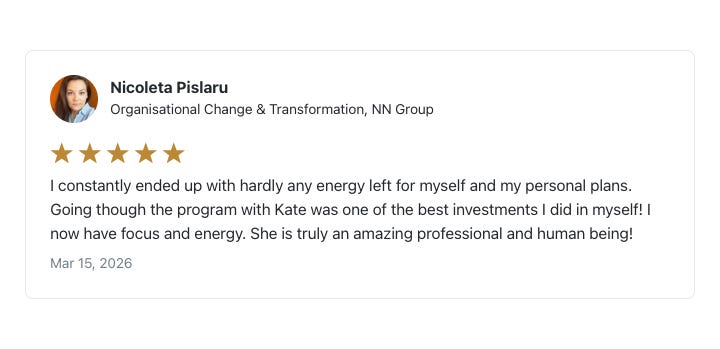
If this resonates and you’re ready to actually free up time from work that simply shouldn’t exist, The Good Busy Reset will take you there step by step.
Because nothing changes if nothing changes. You can’t sweep away the mess with a broom that’s part of the mess.
23,000+ leaders are freeing up time from work that shouldn’t exist with The Good Busy Newsletter. If it helps you, refer it to a friend.
I know productivity - not illustrations. Stickman figures by Zdenek Sasek.
Thank you for being here.
See you next Monday,
Kate
Founder, TheGoodBusy.com

PS: Some work simply shouldn’t exist. Master Good Busy and free up that time for work you’re proud of and what (and who) you love after work.
Here’s how I can help:
See how Good Busy works in my free workshop
Free up 8+ hrs/week from bad busy work inside The Good Busy Reset
Help your teams free up time from work that shouldn’t exist - custom workshop