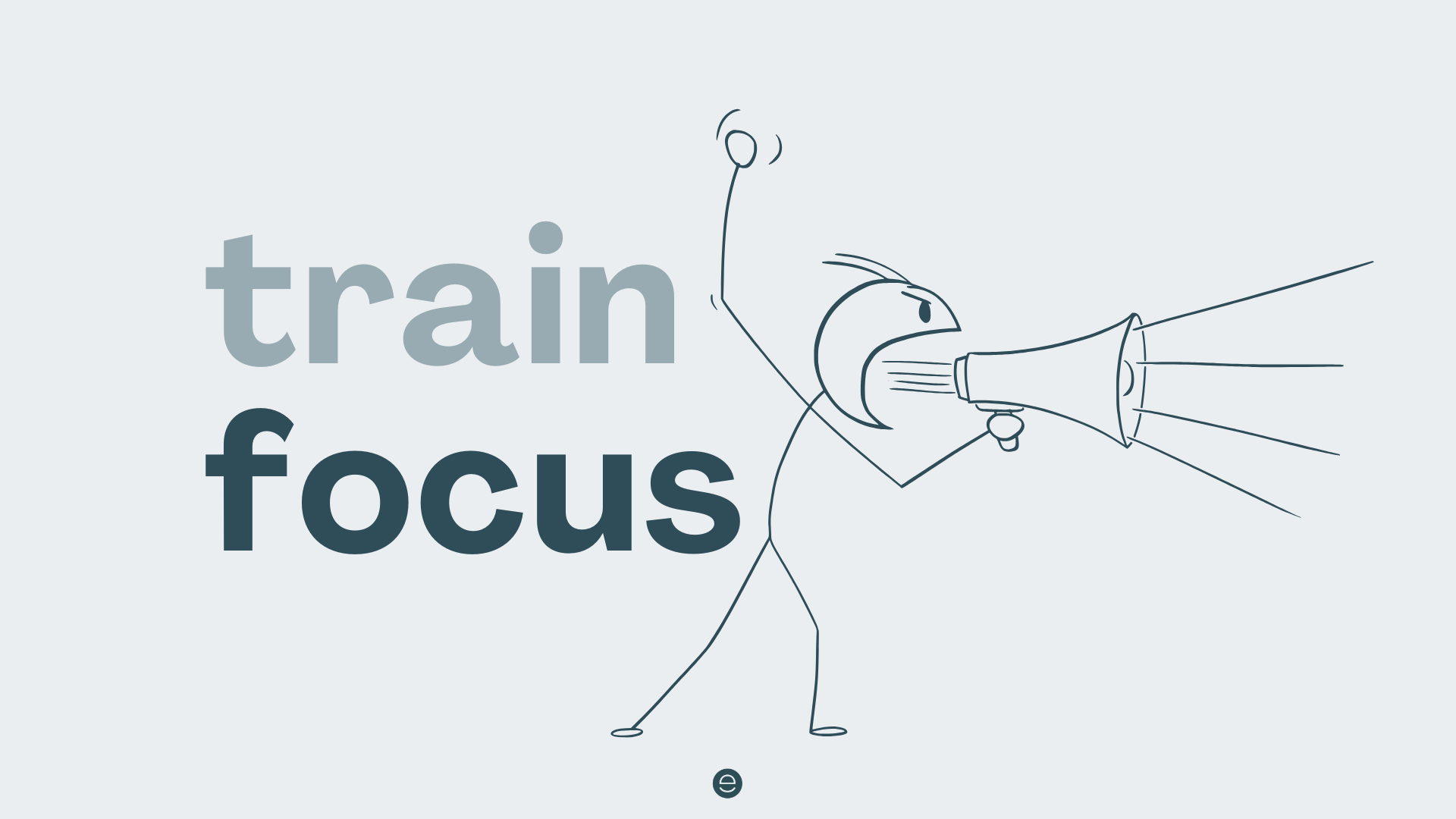
Focus lasts 47 seconds 🧐
Takes 23min to get it back. You can train it.
Read time: 5min
Join 23,172 Good Busy leaders
“The medium is the message." - Marshall McLuhan
Hi,
How was your last week?
Over 400 participants have signed up for my free workshop since last year. When you register, I ask one question: What's your biggest challenge when it comes to productivity and work-life balance?
One answer comes up more than almost any other: focus.
And it shows up in different places.
At work the challenge is the open-plan set up, constant Teams or Slack pings, colleagues’ interruptions, every email announcing another new priority. There’s no time to enjoy one result, one achievement. You have to chase the next one.
Working from home isn’t any different: kids (or pets) ask for attention, house chores literally stare at you, and the guilt of not spending enough time with your partner — or taking care of yourself — adds daily pressure. Because that line between work and home is hard to draw. So it’s hard to be present in both.
If you feel any of that too, you might be saying the problem is your environment — because if you had a quiet space, you’d be able to focus.
But that’s not why focus is hard — for almost everyone.
Why share this with you?
Because today, I’d like to help you find the right answer.
You’re trying to focus in a world that wasn’t designed for it. A world that created overwhelm. A world that suggests that the solution is still to do more and faster. And that’s making your daily world even worse. Way worse. Like a wildfire.
One more tiny push and suddenly you feel everything is burning — at work and at home. The more you try to outrun it with quantity and speed, the more oxygen you give it.
The speed we’re living in, the volume of information we’re exposed to every day — it is not normal. It wasn’t normal even five years ago. We just forget to question it.
the why
Think about what “do more” meant in the 80s. There was no Internet, no social media, no AI. No smartphone in your hand delivering thousands of data points when you haven’t even left the bed. The world was different.
Today, “more” is unlimited. But our capacity to process it isn’t. That’s why in today’s world “more” is literally impossible.
Research by Dr. Gloria Mark has monitored attention spans for nearly two decades. In 2004, the average time a person could focus on a single screen before switching was 2.5 minutes. In 2012, it declined to 75 seconds. Today it’s 47 seconds. And when focus breaks, it takes us an average of 23 minutes to restore it.
Yes. 47 seconds. Then 23 minutes to get back.
But it’s more than a technology influence. It started long before the Internet.
In 1880s, political debates in the US lasted three hours. The opening statement alone was 60 minutes. People were able to follow the long trail of thoughts because they were trained to — through years of reading books.
By the 1960s, political debates had moved to television. The format was reduced to an hour — with an opening statement of only 8 minutes.
Then came posts, tweets, reels, shorts. And the more we consume that way, the harder deep focus becomes even when our environment is quiet. Because our brain adopts the lens of our consumption habits. Our consumption impacts how we think and focus.
Short form of entertainment we consume trains our brains out of focus. Which only means we can train it back in.
I learned this from an amazing video by Jared Henderson — Why we can’t focus— which I genuinely recommend. It connected dots I hadn’t connected before.
the how
Alex Wieckowski — known as Alex & Books, one of my most trusted sources on non-fiction reading, with over 1 million followers — ran a live experiment with his audience earlier this year: training focus through reading books.
Before writing this edition, I reached out to ask what he’d learned.
His biggest lesson: most people try to increase their willpower or motivation to focus. A much better strategy is to decrease your temptations and distractions.
His recommendation: leave your phone in another room, put on noise-cancelling headphones, and open a book. He says this will make you 3-5 times more focused — guaranteed.
My lesson from chatting with Alex: so much of focus is within our control. It’s a muscle we can train, but it’s also a choice we can make.
Distractions can and will exist. There will be more in the future. But giving in to them — or not — is a choice. And intentional choices are only possible when we slow down enough to make them. That’s what strong focus is — learning to slow down.
Reading books is a great place to start. That doesn’t mean you need to enter the reading race. And that also doesn’t mean that all Internet, TV, and social media is bad. In my culture, we say there’s no good without bad. So take the good, become aware of the bad, and don’t let it spark a wildfire you can’t outrun.
Train your focus by switching how — and how much — you consume. The most intentional media today is books.
(In the upcoming editions, I’ll share a 2-minute exercise to train focus. I learned it in yoga. And no — no yogi status required.)
your play of the week
Read one page 📖
This week, take a 5-minute break — every day — to read one page of any book: one you’ve been meaning to start, one you’re halfway through, even one you’ve read before.
The rules to train your focus are simple:
Close every tab
Put your phone in another room (or your desk drawer)
Read one page — more if you want, but one is enough to start
(If you need help focusing, join my free workshop — see how Good Busy works in only 60 minutes.)
Because nothing changes if nothing changes. It’s impossible to focus in a world designed to distract you — but you can choose not to give in.
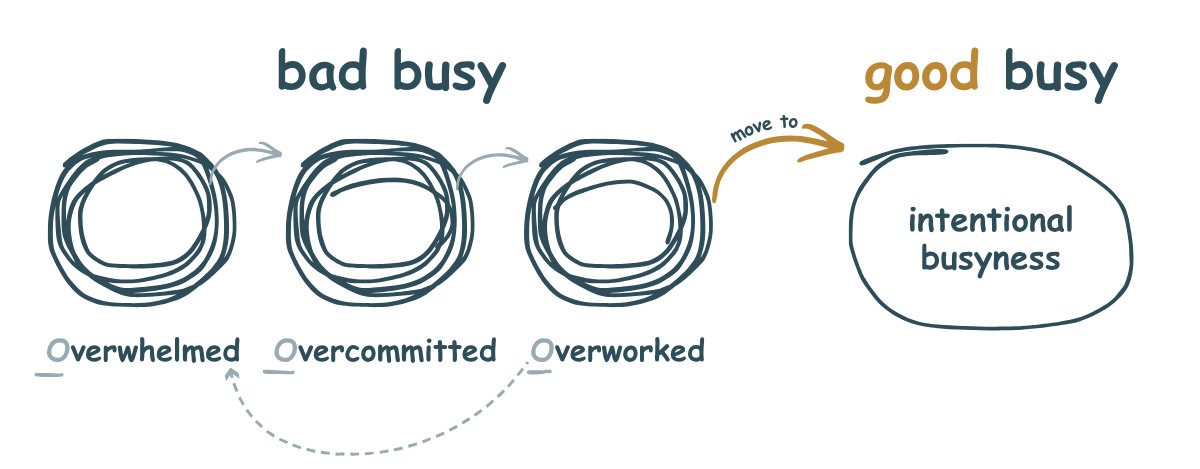
23,000+ leaders are moving closer to Good Busy with The Good Busy Newsletter. If it helps you, refer it to a friend.
I know productivity - not illustrations. Stickman figures by Zdenek Sasek.
Thank you for being here.
See you next Monday,
Kate
Founder, TheGoodBusy.com

PS: Everyone’s busy. Not everyone feels their time is well spent — at work or after. Because busy is human. Good Busy is a skill.
This is how I can help you master it:
See how Good Busy works in my free workshop
Free up 8+ hrs/week from bad busy work inside The Good Busy Reset
Bring a custom workshop or The Good Busy Reset to your team