
Something happened last week... 🎱
I believe it shouldn't have


Read time: 5min
Join 23,020 Good Busy leaders
“Everything should be made as simple as possible, but not simpler." - Albert Einstein
Hi,
How was your last week?
I planned a different topic for today. But last week something happened and I believe it shouldn’t have. Because it’s work that simply shouldn’t exist.
Updating a personal document has been sitting on my to-do list since last year (Yes, I know I’m a productivity coach. It just wasn’t a must-do until now.)
In May, I finally decided to make an appointment. I called the number on the website several times. Nobody answered. So it got moved to June.
Still no luck. Because there’s no email on the website and now it is a must-do, last week, I drove to the public office.
The information officer said I needed an appointment. I explained that nobody answers the phone. They pointed again to the sign:
“Please arrange an appointment.”
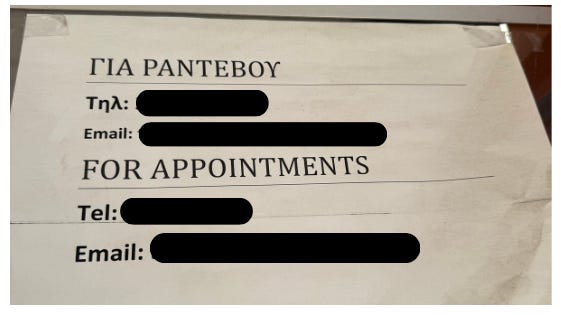
It was the same number, but I called again from the car park. Twice. No answer. But now I had the email. So I emailed.
The next day I got a reply:
“To book appointment, please send these two documents.”
So I did.
The next day they confirmed the appointment with a long list of everything to bring on the day and asked for my phone number.
I shared my number and asked a question (that two more emails later I still don’t have an answer to.)
But the goal to get an appointment is achieved — even if it took three months, a two-hour round trip, and three emails.
Why share this with you?
Not because I can’t handle a few extra emails or hours in the car. But because I’m not the only one emailing.
That public officer most likely receives dozens (if not more) requests like mine every day. Answering the same question three times over. Watching dozens of emails turn into hundreds and stressing to reply each of them as fast as possible (they might even have a KPI.)
Their inbox is full with emails (work) that simply shouldn’t exist. And maybe not just their inbox. And maybe that explains why my appointment is in 5 months…
You might think that’s a silly example. But how many versions of this kind of silly exist in your day?
the why
Here’s what I would have done if I was that public officer.
Update the website and the information sign with one clear email address — no one picks up the phone anyways.
List the two documents required for the booking right there, upfront. Set an auto-reply with an estimated response time (add it to the sign.)
State that emails without required information will not get a response.
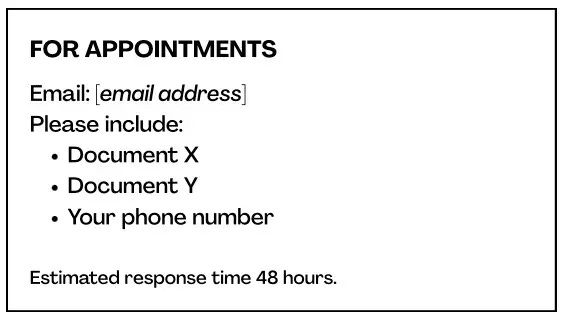
That alone will remove those extra 3 emails per inquiry.
But that’s not how we’re wired.
We’re wired to trust complicated. Simple feels too simple — like it can’t possibly be enough. So instead of one clear step, we add a process. Instead of one email template, we create a system. Instead of asking two yes or no questions, we schedule a two-hour meeting.
We assume that if something feels hard, the solution must be equally hard: it needs a project, a team, a budget. And that assumption is exactly what creates work that shouldn’t exist, why appointments are scheduled 5 months ahead, and a project that started 2 years ago is still a project. But we’ve got something to create a PowerPoint on.
Some cases do need a more thoughtful, complex, and maybe expensive solution. And my example might not be the best — an online appointment system would be a smarter choice. But our tendency to like complicated drags problems for months (years in some case). And our overwhelm drags with it.
We need to learn to think now, not how. Because now — a simple intervention — can solve 80% of the problem.
the how
Here’s another example of thinking now, not how.
A few years ago, I was consulting an HQ team of 10 at a large FMCG company. The goal was to help increase productivity after a headcount freeze (because — as it always is the case — nobody froze the work.)
One leader kept coming back to the same challenge: constant DMs. They couldn’t keep up. It was disrupting their entire day: they struggled to focus and felt guilty whenever they didn’t reply fast enough.
So I asked just two questions:
Who are the DMs from?
What are the DMs about?
Then, we applied the 80/20 rule.
We found that most DMs were from their regional teams (especially new joiners) across dozens of markets. And the most common question was: Where to find information?
This leader was answering (typing) the same thing over and over, every day ruminating about the impossible number of DMs they receive.
Their real problem wasn’t “How to keep up with the DMs and stay focused to do the actual work?” It was the lack of training and information access for their regional teams (a common problem in most teams.)
The solution was a simple shared library and an onboarding guide. They thought we’d come up with a something more elaborate — a tiered response system, a prioritization process, a dedicated channel in Teams.
Something like this:
∫₀⁸ (x³ − 6x² + 12x − 8) dx + lim(n→∞) Σ(8/n²) = 8
When the answer can be this:
4 + 4 = 8
We reach for complicated because it looks smarter. It feels more thorough. It screams effort. But complexity is how we add work that shouldn’t exist. The simplest idea is usually right in front of you if first think now, not how. (And you won’t need to create another PowerPoint.)
So before you go for complicated, try the simple.
If filing is also a problem for you and your team, try a mini course with my system accessible with the upgrade of your subscription.
Each edition of The Good Busy Newsletter takes me on average 5 hours to write.
If it’s helping you, consider upgrading to support my work. You’ll also get access to mini courses (each under 8min) and live conversations.
your play of the week
Find your 4+4 🎱
This week, think of a problem you face or what feels more complicated than it should be, and ask: “What’s the 4+4 version of it?”
Think now, not how. Try the simple first.
If this resonates and you’re ready to actually free up time from work that simply shouldn’t exist, The Good Busy Reset will take you there step by step.
Because nothing changes if nothing changes. And nothing changes, because we’re overcomplicating it.
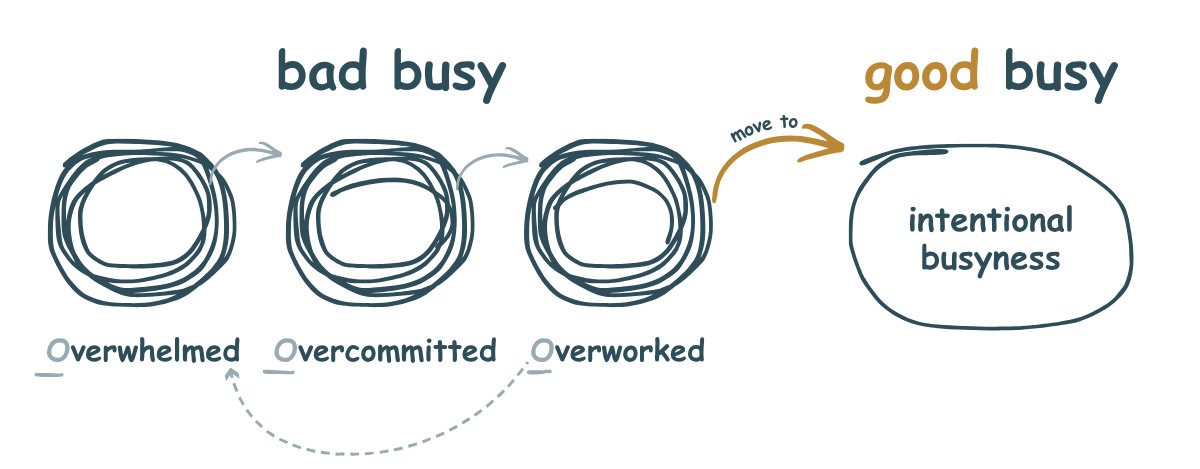
23,000+ leaders are freeing up time from work that shouldn’t exist with The Good Busy Newsletter. If it helps you, refer it to a friend.
I know productivity - not illustrations. Stickman figures by Zdenek Sasek.
Thank you for being here.
See you next Monday,
Kate
Founder, TheGoodBusy.com

PS: Some work simply shouldn’t exist. Master Good Busy and free up that time for work you’re proud of and what (and who) you love after work.
Here’s how I can help:
See how Good Busy works in my free workshop
Free up 8+ hrs/week from bad busy work inside The Good Busy Reset
Help your teams free up time from work that shouldn’t exist - custom workshop
I agree with you, I just shared the same observation on LinkedIn a few days ago.